Which material for your kitchen worktop? Natural stone, ceramic, terrazzo and composite compared
Which material for your kitchen worktop? Natural stone, ceramic, terrazzo and composite compared
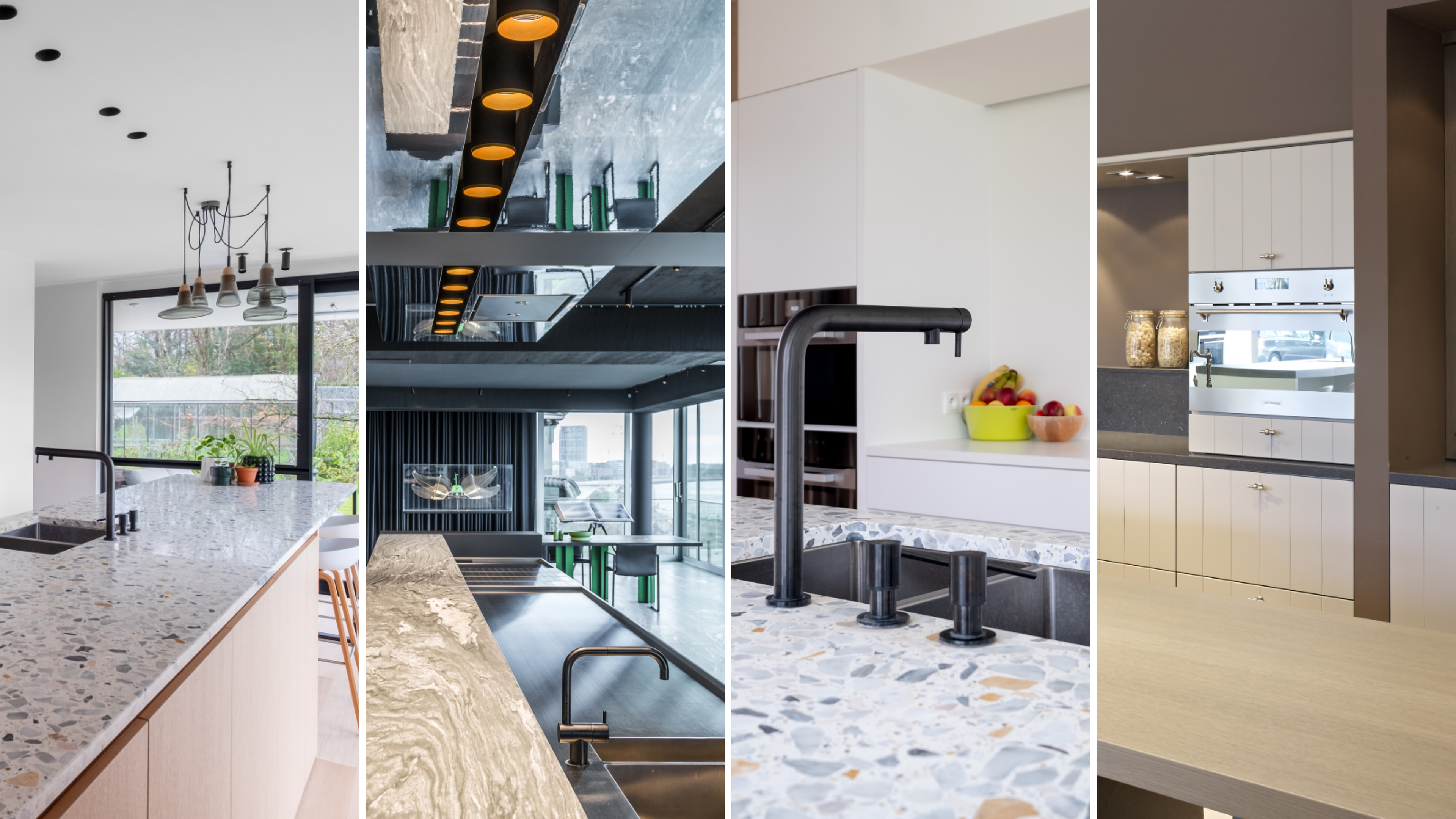
A kitchen worktop is used every day: hot pans, knives, lemon juice, red wine. The material you choose determines how your kitchen will look in ten years' time. In this guide, STONE NV compares the four material families for kitchen worktops: natural stone, ceramic, terrazzo and composite. STONE NV supplies all four and fabricates them to measure in its own workshop in Belgium, for clients across Europe, the United States and the Middle East.
Short answer: which material suits which use?
- Lots of cooking, little maintenance: ceramic, granite or quartzite. Heat-resistant, scratch-resistant and hardly prone to stains.
- A natural look with character: marble or limestone. Beautiful and unique, but sensitive to acids and higher in maintenance.
- A uniform colour and non-porous surface: quartz composite. Stain-resistant, but less heat-resistant.
- A design that stands out: terrazzo. Unique and colourful, but it needs protection against stains.
Kitchen worktop materials compared
- Granite: heat ●●●● · scratches ●●●● · stains ●●●○ · maintenance: low · speckled, natural
- Quartzite: heat ●●●● · scratches ●●●● · stains ●●●○ · maintenance: low · marble look, natural
- Marble and limestone: heat ●●●○ · scratches ●●○○ · stains ●○○○ · maintenance: high · unique, warm patina
- Ceramic: heat ●●●● · scratches ●●●● · stains ●●●● · maintenance: very low · any look, including natural stone
- Terrazzo: heat ●●●○ · scratches ●●○○ · stains ●●○○ · maintenance: medium · colourful, distinctive
- Quartz composite: heat ●●○○ · scratches ●●●○ · stains ●●●● · maintenance: low · even, uniform
●●●● = excellent · ●○○○ = sensitive. A general guideline: exact properties vary by stone type and finish.
Want to see the materials for real? Discover our kitchen worktops in natural stone, ceramic and terrazzo.
Granite: the strong classic
A granite worktop is one of the most robust choices: heat-resistant, scratch-resistant and low-maintenance. Granite is an igneous rock formed when magma cools slowly deep in the Earth's crust. It consists mainly of quartz, feldspar and mica, which gives it its speckled grain and high hardness (around 6 to 7 on the Mohs scale). You can briefly set a hot pan on it, and cutting on the surface rarely leaves marks. Dark granites are barely porous; lighter types are best impregnated against stains.
Marble and limestone: beautiful, but sensitive to acids
Marble and limestone give a kitchen a timeless, warm look, but they are sensitive to acids and stains. Marble is a metamorphic rock and limestone a sedimentary rock; both consist of calcium carbonate. As a result, they react to acids such as lemon juice, vinegar and wine, which leave dull marks. They are also softer than granite and can show fine scratches. If you can live with that, you get a worktop that develops a beautiful patina over the years. Impregnation and wiping up stains quickly are essential.
Quartzite: the look of marble, the strength of granite
Quartzite combines the elegant veining of marble with a hardness that matches granite. Quartzite is a metamorphic rock formed from sandstone under high pressure and temperature. It is highly scratch- and heat-resistant, and less sensitive to acids than marble. Don't confuse it with quartz composite: quartzite is a 100% natural stone, quartz composite an engineered material.
Ceramic: the easiest worktop to maintain
A ceramic worktop is non-porous, heat-resistant, scratch-resistant and virtually maintenance-free. Ceramic slabs (also called sintered ceramic or sintered stone) are made from clay and minerals fired under very high pressure and temperature. As a result, they don't absorb moisture: wine, oil or coffee stains don't soak in, and no impregnation is needed. They are available in almost any look, from marble and natural stone to concrete. At STONE NV you'll find large-format ceramic worktops in the Ceratop collection, with materials from Ascale, Coem, Neolith and Inalco.
Disadvantages of a ceramic worktop: the edges are more prone to chipping from a hard knock, and on some slabs the pattern is only on the surface, so a damaged edge is more visible. Skilled installation and a well-chosen edge finish reduce that risk.
Terrazzo: a worktop that stands out
Terrazzo gives a kitchen a distinctive, colourful character, but the surface needs protection against stains. Terrazzo consists of chips of marble, natural stone or glass set in a binder. STONE NV produces it under the name Bomarbre, including Bomarbre XXL in large format for seamless worktops. Cement-based terrazzo is porous: good impregnation and wiping up stains quickly keep the worktop looking its best.
Composite: even and stain-resistant
A composite worktop is non-porous and stain-resistant, but less heat-resistant than natural stone or ceramic. Quartz composite (also called quartz resin or engineered stone) consists largely of crushed quartz bound with resin. The result is an even, uniform worktop that needs little maintenance. However, the resin can discolour or be damaged by high temperatures: always use a trivet for hot pans.
What determines the price of a kitchen worktop?
The price of a worktop doesn't depend on the material alone. These factors also play a part:
- Material and rarity: exclusive marbles and quartzites cost more than common granites.
- Size and thickness: larger slabs and thicker worktops require more material.
- Finish and edges: a mitred edge or a special profile takes extra work.
- Fabrication: cut-outs for the sink, hob and tap, and the number of joints.
- Installation: transport, fitting and any splashbacks.
See our price list for an up-to-date overview.
Made to measure in our workshop
STONE NV supplies natural stone, ceramic, terrazzo and composite from a single source and finishes every worktop in its own workshop: from measuring and cutting to cut-outs and edge finishing. That way you can compare materials side by side and get advice from one point of contact. Would you like to have your kitchen worktop made to measure? Discuss your project with our workshop, or request a sample.
Frequently asked questions about kitchen worktops
Which kitchen worktop is the strongest?
Ceramic, quartzite and granite are the strongest choices: they are hard, scratch-resistant and heat-resistant. Ceramic is also non-porous and therefore the least prone to stains.
Is marble suitable for a kitchen?
Yes, if you accept the patina. Marble is sensitive to acids and softer than granite, so lemon juice, vinegar and wine can leave dull marks. With impregnation and stains wiped up quickly, a marble worktop stays beautiful, but it will never be as low-maintenance as ceramic or granite.
What are the disadvantages of a ceramic worktop?
The edges can chip from a hard knock, and on some slabs the pattern is only on the surface. Repairs are more difficult than with natural stone. On the other hand, you get a non-porous, heat-resistant and virtually maintenance-free surface.
Composite or ceramic: which is better?
Both are non-porous and stain-resistant. Ceramic is more heat- and UV-resistant, while composite is less prone to chipping at the edges. If you cook a lot and like to put a hot pan down, ceramic is the better choice.
What is the difference between Dekton and ceramic?
Dekton is a brand name for sintered ceramic (sintered stone), a form of ceramic in large slabs. It is comparable to the ceramic worktops from Ascale and Neolith that STONE NV fabricates.
How thick should a kitchen worktop be?
It depends on the material and the design. Natural stone, terrazzo and composite are usually fabricated thicker than ceramic slabs, which are very strong even in a thin version. With a mitred edge, any worktop can look thicker.
Can you put a hot pan on granite?
Granite handles high temperatures well, as do ceramic and quartzite. We still recommend using a trivet: sudden temperature changes and grease can leave marks. On marble, limestone, terrazzo and composite, always use a trivet.
How do I care for a stone worktop?
Clean with lukewarm water and a pH-neutral product, wipe up stains quickly and avoid harsh or acidic cleaning agents. Natural stone and terrazzo are best impregnated. Find more tips in our article on cleaning and maintenance.