Terrazzo tiles, poured floor or terrazzo look: which suits your project?
Terrazzo tiles, poured floor or terrazzo look: which suits your project?
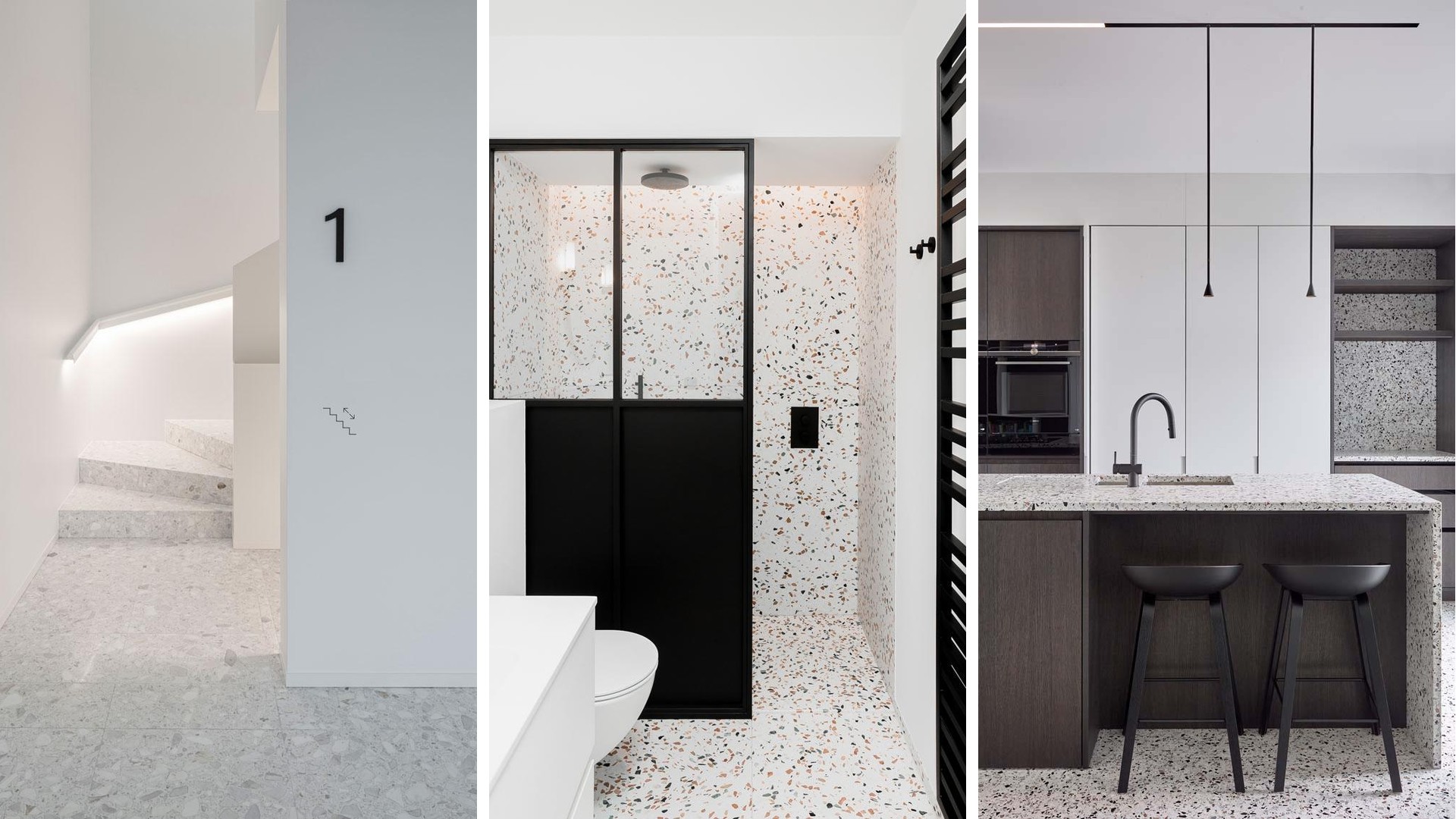
A terrazzo floor is timeless, colourful and almost indestructible. But choosing terrazzo today also means making a choice: terrazzo tiles, a poured terrazzo floor or ceramic tiles with a terrazzo look? They look alike, but differ greatly in material, installation, maintenance and price. In this guide, STONE NV, a terrazzo producer since 1923, compares the three options for clients across Europe, the United States and the Middle East.
Short answer: which option suits you?
- Real terrazzo, quick to install and easy to repair: terrazzo tiles or slabs. No drying time on site, and a damaged tile can be replaced on its own.
- A completely seamless floor: a poured terrazzo floor, cast and ground on site by a specialist.
- The look of terrazzo, with minimal maintenance: ceramic tiles with a terrazzo look. Not real terrazzo, but non-porous and with no impregnation needed.
What exactly is terrazzo?
Terrazzo is a material, not a pattern. It consists of chips of marble, natural stone or glass in a cement or resin binder, ground to a smooth surface once it has hardened. In Belgium, terrazzo is also known as granito. A terrazzo-look tile is something else: a ceramic tile with the terrazzo pattern printed on it. Read more about its origins and types on our terrazzo page.
The three options explained
1. Terrazzo tiles and slabs
Terrazzo tiles are produced in the factory and delivered ready to lay. At STONE NV we make them under the name Bomarbre, in two families:
- Cement-bound terrazzo: marble, granite or quartz chips in a pigmented cement binder. Pressed tiles such as Bomarbre Compact (400x400x15 and 600x600x20 mm) and Bomarbre Classic, or tiles cut from slabs such as Bomarbre XXL, up to 1200x1200x30 mm. Bomarbre Classic is also available made to measure in 2 or 3 cm slabs, for example for stairs, thresholds and vanity tops.
- Resin-bound terrazzo: marble or quartz chips bound with high-quality resin, such as Bomarbre Marble-Resin and Bomarbre Quartz-Resin. Thinner, and available polished or honed.
2. Poured terrazzo floor
For a poured floor, the terrazzo mix is cast on site, cured layer by layer and then ground and polished in place. The result is a seamless floor, apart from the necessary expansion joints. It requires a specialist contractor, a long drying and curing time, and a dusty finishing process in the home.
3. Ceramic tiles with a terrazzo look
Porcelain tiles with a printed terrazzo pattern. They are thin, non-porous and need no impregnation. At STONE NV you'll find this look in the Granitocer collection, in seven colours and in a 595x595 mm format.
Comparison: tiles, poured floor or terrazzo look
- Material: tiles and poured floors are real terrazzo; terrazzo look is printed ceramic.
- Installation: terrazzo tiles and ceramics are bonded like a tiled floor; a poured floor is cast, cured and ground on site.
- Lead time: tiles and ceramics can be walked on quickly; a poured floor needs a long drying and curing time.
- Joints: tiles have narrow joints (minimum 3 mm, 5 mm on underfloor heating); large formats such as 1200x1200 mm reduce the number of joints. A poured floor is seamless, apart from expansion joints.
- Underfloor heating: possible for all three, with correct installation.
- Repair: a damaged tile can be replaced on its own; repairing a poured floor is harder and often remains visible.
- Maintenance: real terrazzo is impregnated and can be reground after years; ceramics need no impregnation, but cannot be reground.
- Look: real terrazzo has depth, with chips running through its full thickness; on ceramics, the pattern sits on the surface.
When should you choose terrazzo tiles or slabs?
Terrazzo tiles are the most flexible choice for real terrazzo. They are produced and checked in the factory, so you know in advance exactly which colour and chips you'll get. Installation is quicker and involves no wet finishing in the home, and you can choose between small formats and large slabs for an almost seamless look. Stairs, skirtings, thresholds and vanity tops are also available in the same terrazzo, for a continuous whole.
When should you choose a poured floor?
A poured floor is the choice if you want no joints at all. Think of large open spaces, shops or public buildings with a completely continuous floor surface. Bear in mind a longer lead time, a specialist contractor, a correctly designed screed with expansion joints and more difficult repairs in case of damage. Looking for a look with few joints, without those drawbacks? Large terrazzo slabs such as Bomarbre XXL are a good alternative.
Real terrazzo or terrazzo-look ceramics?
Choose real terrazzo for depth, authenticity and a floor that lasts for generations. Because the chips run through its full thickness, terrazzo can be reground after years to look as good as new. Choose terrazzo-look ceramics for maximum ease of use: non-porous, stain-resistant, acid-resistant and with no impregnation needed. STONE NV supplies both, so you can compare Bomarbre and Granitocer side by side in our showroom.
What determines the price of a terrazzo floor?
- Type: terrazzo-look ceramics are usually the most affordable choice; a poured floor is usually the most expensive because of the work on site.
- Binder and chips: cement- or resin-bound, and the type and size of the chips.
- Size and thickness: large slabs and thicker tiles require more material.
- Bespoke pieces: stairs, thresholds, skirtings and vanity tops in the same terrazzo.
- Installation: the subfloor, underfloor heating and finishing on site.
See our price list for an up-to-date overview, or request a sample to compare the colours at home.
Frequently asked questions about terrazzo floors
What is the difference between terrazzo tiles and a poured terrazzo floor?
Terrazzo tiles are produced in the factory and bonded like a tiled floor, with narrow joints. A poured floor is cast and ground on site and is seamless, but needs a longer lead time and a specialist contractor. Both are real terrazzo.
Is a ceramic terrazzo look real terrazzo?
No. Terrazzo-look ceramic tiles are porcelain tiles with a printed terrazzo pattern. They are easier to maintain, but lack the depth of real terrazzo and cannot be reground.
Can terrazzo be used with underfloor heating?
Yes. Cement-bound terrazzo tiles such as Bomarbre are suitable for underfloor heating, provided they are installed correctly: a decoupling membrane, a joint of at least 5 mm and expansion joints in the screed every 40 m². For resin-bound terrazzo, we're happy to advise on the right installation.
How thick is a terrazzo floor?
Bomarbre cement-bound terrazzo tiles are 15 to 30 mm thick, depending on the format; resin-bound tiles are thinner. Terrazzo-look ceramic tiles such as Granitocer are about 9.5 mm thick.
What is granito?
Granito is the Belgian name for terrazzo: a floor of marble or stone chips in a binder, ground smooth. Many older Belgian homes still have an original granito floor.
Can terrazzo be used outdoors?
Terrazzo tiles and terrazzo-look ceramics are primarily intended for indoor use. Looking for a durable, slip-resistant floor for your terrace? Take a look at our terrace tiles in natural stone and ceramics.
How do I care for a terrazzo floor?
Real terrazzo contains marble and is therefore sensitive to acids: clean with a pH-neutral product, impregnate after installation and avoid vinegar and limescale removers. Find more tips in our article on cleaning and caring for natural stone.