Natural Stone vs. Ceramic vs. Composite: A Complete Comparison
Natural Stone vs. Ceramic vs. Composite: A Complete Comparison

In construction and renovation projects, a common question arises: do you choose natural charm, modern ceramics, or innovative composite materials? In Belgium, the Netherlands, and France, natural stone, ceramic, and composite are all popular choices for floors, walls, terraces, and even kitchen countertops. Each material has its own character, applications, and points of consideration, and there is no such thing as a "bad" choice. In this extensive article, we compare these options based on appearance, durability, maintenance, and applications. This will allow you to determine, with 100% accuracy and the right focus, which material best suits your project. We will also refer to relevant products from STONE NV (such as Granitocer, Geology, Bomarbre Terrazzo, quartzite flagstones, and Sutto Travertine) to illustrate the differences.
Natural Stone: Natural Power and Timeless Elegance
Natural stone is, as the name suggests, formed entirely by nature. It is extracted directly from quarries worldwide and subsequently sawn to size and finished. Popular types of natural stone include granite, blue limestone (Belgian Blue Stone), and marble, but limestone, slate, travertine, and quartzite are also among the possibilities. Because no two stones are identical, natural stone always possesses a unique, authentic look. The material radiates class and luxury and "lives" with the space by developing its own patina over the years. This timeless character ensures that natural stone feels at home in both classic and modern interiors.

Properties and Advantages of Natural Stone
Natural stone is highly durable and, with proper maintenance, can last for generations. Every tile or slab has a different pattern and color nuance, providing a natural, warm appearance. Furthermore, natural stone ages beautifully—consider a marble floor that still retains its charm after several decades. Many types of natural stone (e.g., slate, granite) are naturally hard rocks that are highly resistant to wear and tear. Natural stone also handles heat well, which is practical for areas around a fireplace or as a kitchen countertop (granite, quartzite). Finally, a high-quality natural stone element often adds value to a property thanks to its luxurious appearance and exclusive character.
Points of Consideration
Natural stone is more porous than ceramic or composite. If left untreated, it can absorb stains or become dull due to acids. Periodic treatment with an impregnating agent (approximately once every 5 years) is recommended to prevent stains and moisture from taking hold. With such a protective layer, however, you do not need to fear stains or frost damage, even when applying natural stone outdoors. For sensitive stone types (e.g., marble, travertine), be careful with acidic cleaning agents; it is better to use pH-neutral cleaners. Natural stone is also heavier in weight than, for instance, ceramic tiles—a practical point to keep in mind for installations on upper floors or weaker subfloors. This higher weight is a testament to quality, but sometimes requires additional structural support.

Applications of Natural Stone
Natural stone is incredibly versatile and can be used almost anywhere:
- Interior: Think of marble or bluestone floors in living rooms, entrance halls, or bathrooms, which immediately add atmosphere. Natural stone wall cladding (e.g., a slate accent wall) adds texture and character. Staircases can also be crafted entirely from natural stone for a lasting, beautiful finish. For kitchen countertops and tabletops, natural stone (such as polished granite or quartzite) is highly favored for its heat resistance and luxurious appearance. Even with underfloor heating, natural stone is perfectly compatible, provided there is correct installation and impregnation.
- Exterior: In the garden and around the house, natural stone truly shines in terraces, garden paths, driveways, and facade cladding. In Belgium, for example, "Arduin" (Belgian Blue Stone) has traditionally been widely used as terrace or doorstep stone due to its frost resistance and timeless look. Other limestones and quartzites are also popular for outdoor use. Flagstones—irregular broken stones—are often chosen for terraces or walkways where a rustic, organic style is desired. STONE NV offers exclusive quartzite flagstones such as Albino and Flamingo, which bring an outdoor space to life thanks to their unique color palette (ranging from soft white/yellow to warm pink). For gardens, slip resistance and frost resistance are vital: many types of natural stone meet these requirements, especially when the stone is correctly finished (flamed, sandblasted, or honed surface for grip). A prime example is Sutto Travertine, a Hungarian travertine available at STONE NV. This stone has a rich history, having been used by the Romans for roads and forts, and combines aesthetics with robustness. In the Sutto Vein Cut finish, it is sawn in the direction of the natural veins, creating an elegant linear pattern. Functionally, Sutto Travertine performs excellently: high compressive strength, low water absorption, and outstanding frost and salt resistance make this stone suitable for both indoors and outdoors. In other words, with the right choice and treatment, natural stone can be used in almost any conceivable application, from bathrooms to facades and from kitchens to pool terraces.
Ceramic: High-Tech Tiles with Endless Possibilities
Ceramic (in the context of tiles and slabs) is a man-made material based on clay, sand, and minerals, fired at high temperatures. Modern ceramics, often in the form of porcelain or gres porcellanato, are extremely hard, dense in structure, and usually finished with a wear-resistant top layer or glaze. As a result, ceramic tiles are waterproof, stain-resistant, and scratch-proof, while visually they can take on any possible appearance. Thanks to digital printing and pressing techniques, ceramic can imitate almost any conceivable material, whether it be marble, limestone, concrete, or wood. Furthermore, the colors of ceramic remain unchanged even after years of intensive use or exposure to sunlight; they are completely UV and color-fast.

Properties and Advantages of Ceramic
Ceramic tiles are known for being low-maintenance. They do not need to be impregnated and are easy to clean; usually, regular vacuuming and mopping with a neutral cleaning agent is sufficient. Stains do not penetrate the material due to the dense top layer, and scratches are unlikely in daily use. Because ceramic is fired at very high temperatures, the material is extremely hard and wear-resistant. It can withstand high pressure, making it suitable for high-traffic areas (shops, entrance halls) or, for example, a garage. Ceramic is also frost-resistant, provided you choose frost-free quality products, making it ideal for outdoor use in the Dutch and Belgian climates with their winters. Another advantage is the low weight per m² compared to solid natural stone: ceramic tiles are thinner (usually 1 cm for indoors, 2 cm for outdoors), which facilitates handling and sometimes allows for installation on weaker subfloors. And let’s not forget: the design possibilities are endless. You can choose from countless styles, sizes (from mosaics to XXL slabs), and finishes (matte, glossy, textured). Modern ceramic is so well-made that it is hardly distinguishable from real natural stone in appearance, while providing more technical certainty.
Points of Consideration: Ceramic has few disadvantages, but there are a few points to consider. For instance, ceramic tiles without underfloor heating can feel a bit colder to the feet than wood or carpet, though this applies equally to natural stone. Furthermore, ceramic is rock-hard, which means falling objects break more easily (glassware) and the tile itself is less forgiving than a resilient floor. In exceptional cases, a ceramic tile can crack—for example, due to a heavy impact or if the subfloor is not level. However, this is rare with correct installation. Should ceramic tiles sustain a deep scratch, the damage may be almost invisible in "full-body" unglazed tiles; in glazed tiles, the base color becomes visible under the glaze layer, making the scratch more noticeable. Fortunately, ceramic tiles are very scratch-resistant, so this scenario hardly ever occurs. Finally, the hard tile requires a good subfloor and installation with the correct adhesive and grout, but that is the case for any floor.
Applications of Ceramic
Ceramic is universally applicable today, in both residential and commercial projects. Some key applications include:
- Interior: Ceramic floors are popular in kitchens and bathrooms because they are insensitive to water, dirt, and cleaning agents. You can spill wine or oil without worry; a ceramic tile absorbs nothing and does not stain. For bathrooms, there are anti-slip versions or textures that prevent slipping. In living rooms and bedrooms, people often choose ceramic with a natural stone or wood look for a sleek yet warm atmosphere. Thanks to good heat conduction and low thickness, ceramic tiles are perfect for underfloor heating; your floor is then pleasantly warm and energy-efficient.

Ceramic wall tiles are commonly found in kitchens (backsplashes), showers, and toilets due to their ease of maintenance. Additionally, there are innovative large ceramic slabs (up to 3m x 1m) used for custom kitchen countertops, shower walls, or tabletops. Materials such as Dekton and Neolith also fall under ceramic composites; they offer heat- and scratch-resistant surfaces for countertops, with the benefit of thin profiles and seamless finishes.
Exterior: For terraces, balconies, and garden paths, ceramic is becoming increasingly popular. The major advantage outdoors is that ceramic tiles are frost- and thaw-resistant and require no maintenance such as sealing or moss removal. They also retain their color under UV light, which can cause some natural stones to fade or change slightly after years of exposure. Ceramic is therefore a safe choice for a terrace that looks just as new after 10 years. In the Netherlands and Belgium, we see many terraces featuring ceramic tiles in concrete or stone looks to create a modern, sleek garden. A current trend is extending the same tile from indoors to outdoors: a smooth version inside and the same tile with an anti-slip finish outside. This creates one harmonious flow from the living area to the terrace. For pool edges and ponds, special L-shaped ceramic coping stones exist—for example, in the Geology collection by STONE NV—allowing you to combine the elegant look of limestone with the practical demands of a pool environment (no staining from chlorine or salt). Finally, ceramic is sometimes used as facade cladding: thin, large-format slabs can be attached to a facade structure, giving you the appearance of natural stone or metal on a maintenance-free exterior. This application requires specific techniques but illustrates just how versatile ceramic is.
STONE NV capitalizes on the versatility of ceramic with specialized collections. For instance, there is Geology, a ceramic tile series that faithfully mimics the warm appearance of limestone with subtle fossil details and shades. Thanks to advanced porcelain technology, Geology tiles offer the charm of real limestone from Egypt, Croatia, or Spain without the typical sensitivity to stains, acids, or scratches. Furthermore, Geology is available in both thin indoor formats and 20 mm thick outdoor tiles, making a continuous indoor-outdoor floor possible.
Another eye-catcher is Granitocer, the ceramic terrazzo collection by STONE NV. These tiles combine the iconic character of traditional Italian terrazzo floors with the benefits of high-tech porcelain. With Granitocer, you get the same playful grain structure and rich color nuances that make real terrazzo so beloved, but without the disadvantages of cement-bound floors (no stain sensitivity, no wear). The tiles have a dense, scratch- and stain-resistant surface, ideal for high-traffic areas in homes or public buildings. Granitocer is available in several stylish colors (from neutral tones like Blanco and Diamante to expressive colors like Alpi or Pastel), offering a suitable terrazzo-look tile for every interior. Thanks to digital printing, the tiles show subtle variations and lifelike details, making the result almost indistinguishable from handcrafted terrazzo. At the same time, you benefit from the ease of maintenance and reliability of ceramic; a Granitocer floor stays beautiful for years without the hassle. These examples demonstrate how ceramic provides new design possibilities: from a sleek marble look in the bathroom to a colorful terrazzo tile floor in the hall, all with the security of a wear-resistant, low-maintenance surface.
Composite: Innovative Combinations of Nature and Technology
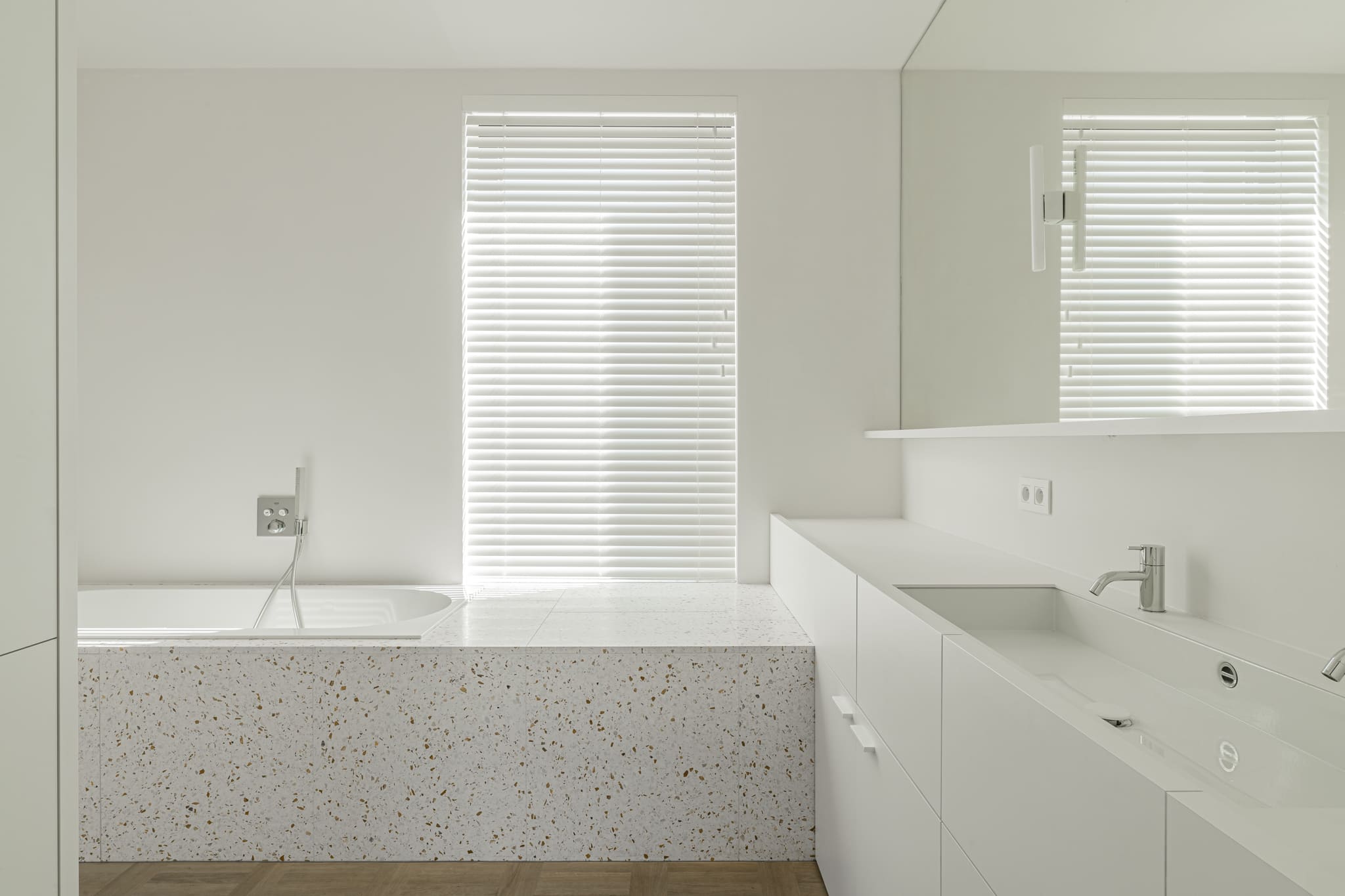
In this context, the term composite refers to artificially composed stone types that combine natural minerals with modern binding agents. The most well-known example is quartz composite (also called engineered stone), which consists of approximately 90% ground quartz sand bound together with 10% high-tech resins. Another example is terrazzo, a traditional material of marble or granite granules in cement, which is effectively also a composite. Composites attempt to unite the best of both worlds: the natural appearance and sturdiness of stone on one hand, and the consistent quality and versatility of an industrial product on the other. This allows composites to achieve properties that are harder to find in pure natural stone, such as absolute color uniformity, extra-high stain and scratch resistance, or specific colors and patterns that are rare in nature.
Properties and Advantages of Composite Materials
While there are various types of composites, they share several common advantages: they are generally non-porous or very dense, meaning they hardly absorb stains and are highly hygienic (leaving no room for bacteria). They are color-fast; because the composition is controlled, you get a uniform color without natural variations (unless deliberately added for effect). Furthermore, composite is very hard and durable; quartz composite, for example, is harder than most marble types and less brittle, resulting in high resistance to scratches and impacts.
Composite also scores well against acids and chemicals: where natural stones like limestone can be etched by acids (vinegar, lemon), quartz composite remains unaffected. Regarding heat resistance, composites can handle a lot; they are suitable for use in kitchens and near fireplaces, though one should avoid placing red-hot objects directly on a quartz composite surface to prevent thermal shock or discoloration of the resin. Brief heat up to ~150°C is generally not an issue, but the use of trivets for pans and appliances remains recommended—a small precaution to keep your surface beautiful for a lifetime. In general, a well-manufactured composite material has excellent mechanical properties, is low-maintenance, and lasts a very long time without loss of quality.

Types of Composite and Applications
Composites can be broadly divided into two groups: resin-bound composites and cement-bound composites.
Resin-bound composite primarily includes quartz composite (such as Silestone, Caesarstone, etc.), but also variants with marble granulate. These materials are pressed in factories under high pressure and vacuum. The resulting product, often in slab form, is ideal for applications such as kitchen countertops, bathroom vanities, stair treads, and other custom surfaces. Thanks to the resin, the material is completely dense and insensitive to stains. Quartz composite has the look and feel of natural stone but offers even higher quality in certain respects. The color consistency is unparalleled, making large surfaces beautifully homogeneous. You can choose from dozens of shades, from radiant white to deep black, often with speckles or veins to resemble marble or granite.
Benefits include easy maintenance, acid resistance, scratch resistance, and durability. It is no coincidence that quartz composite is seen as the ideal material for heavily used kitchen countertops; it is hygienic (food-safe) and remains impeccable for years, even with spills of coffee, wine, or lemon. In addition to slabs, resin-bound composite is also used for items like shower trays and washbasins (cast composite), and there are even floor tiles available in resin-bound terrazzo for those who want a seamless retro-look floor.
Cement-bound composite refers mainly to terrazzo (sometimes also called granito). This material has existed for centuries: traditional terrazzo is made by casting pieces of marble, granite, quartz, and/or glass into a cement matrix, allowing it to harden, and then polishing it to a smooth finish. The result is the colorful, speckled surface we recognize from classic terrazzo floors in Art Deco homes, which is completely back in style today. Terrazzo is considered atmospheric and creative; you can coordinate the colored granules with the interior design, and every floor is unique.
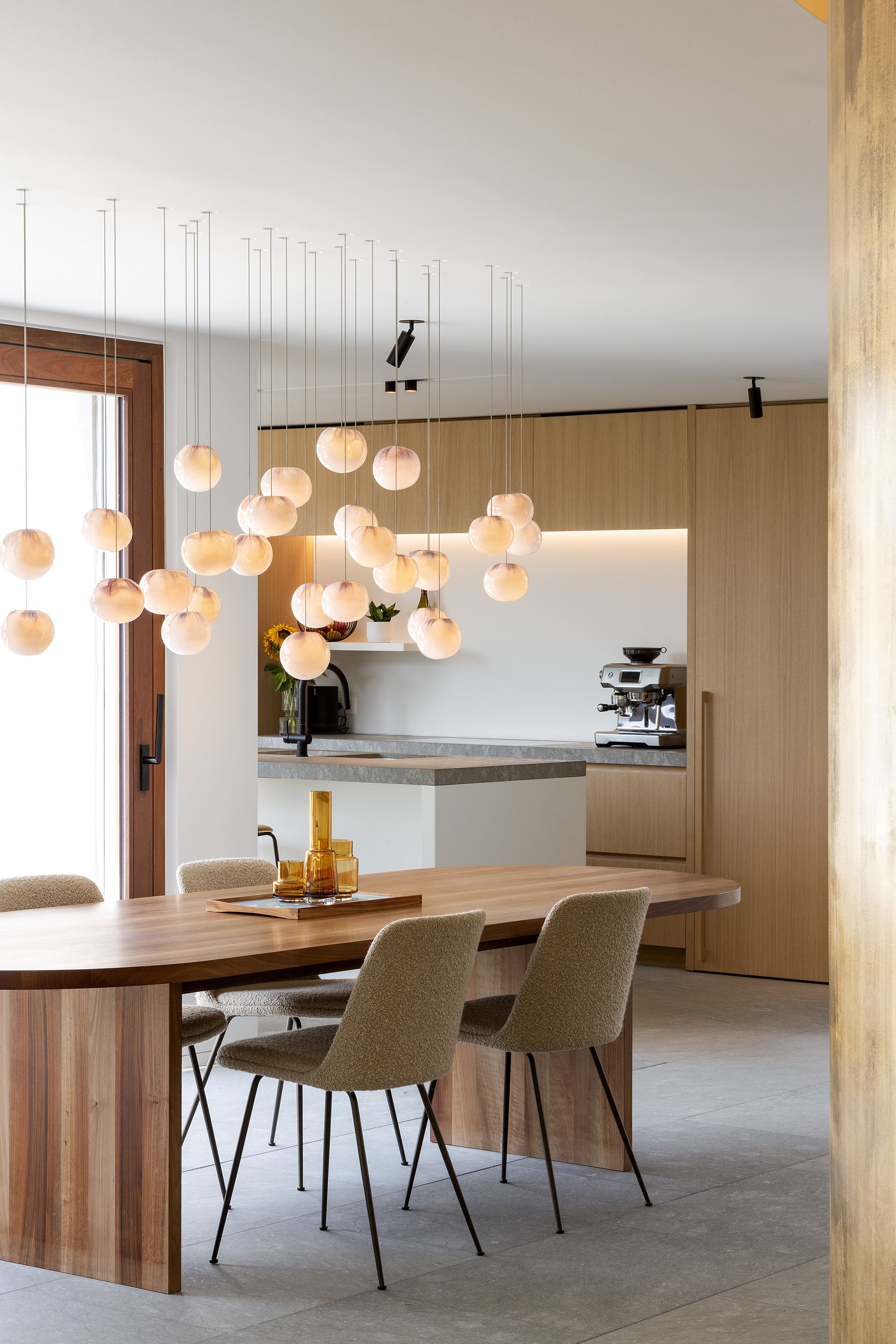
However, classic terrazzo (just like natural stone) requires a proper finish and periodic maintenance (impregnation and polishing) to keep the surface dense and stainless, especially in the case of continuous poured floors.
Nowadays, however, prefab terrazzo tiles and slabs are also available. These are industrially manufactured, resulting in very high quality and density. STONE NV is actually its own manufacturer of terrazzo under the brand name Bomarbre. With a rich tradition of craftsmanship dating back to 1923, STONE produces terrazzo tiles and slabs in-house, utilizing various technologies to ensure the right wear resistance, color consistency, and finish tailored to the application. Examples include Bomarbre Classic tiles (traditional terrazzo in timeless colors), Bomarbre XXL (large slabs cut from a single block, ideal for walls or stairs), and Bomarbre Compact. The latter is made via a unique process of vibro-compaction under vacuum, making these cement-bound natural stone composite tiles exceptionally resistant to pressure, stains, wear, weather, and UV light.
In addition to cement as a binder, STONE NV also uses synthetic resin for certain terrazzos. Bomarbre Marble-Resin, for example, combines real marble granules with colored high-quality resin. Terrazzo, whether in tiles, slabs, or cast on-site, is widely used for flooring (homes, hospitality, shops), but also for stair cladding, kitchen countertops, tables, and even facade panels. Thanks to its "retro look in a modern jacket," we see terrazzo returning to trendy interiors: from hip coffee bars with colorful terrazzo floors to designer bathrooms with terrazzo washbasins. It is a wonderful example of a composite material that unites traditional charm with modern technology.
Points of Consideration for Composites: Every type of composite has its own specific points of attention. With quartz composite, as mentioned, one must be careful with very high point loads or heat (for example, do not place a glowing hot pan directly from the stove onto the surface). Although composite tolerates heat better than most laminate or plastic tops, direct contact with high temperatures is a potential weak spot due to the resin component. Furthermore, aggressive chemicals (corrosive substances, oven cleaners) can dull the surface of some composites; therefore, always use appropriate cleaning agents or simply mild soapy water, which usually suffices. Terrazzo and cement-bound composites, like natural stone, must be impregnated to increase their stain resistance unless they have already been treated in the factory. Finally, a composite material is only as good as its manufacturer; choose reputable brands or suppliers to ensure the composition is sound (correct ratios and high-quality resins). At STONE NV, this is a top priority: Bomarbre terrazzos are the result of years of development, combining craftsmanship with high-tech.
Composite Applications in Brief
- Quartz Composite (Engineered Stone): Primarily used for kitchen countertops, island tops, bathroom vanities, shower walls, and sills. Also popular for windowsills and as furniture cladding (e.g., table bases) to achieve a uniform stone look. Quartz composite is seen less frequently in flooring, except perhaps as large tiles in public spaces where extreme load-bearing and stain resistance are required.
- Terrazzo: An unmistakable favorite for floors in both retro and modern interiors—think of the entrance hall of a manor house or the floor of a trendy restaurant. Additionally used for stairs (both treads and landings can be cast in terrazzo or clad with slabs for a seamless monolithic look). In kitchens, terrazzo appears as a countertop or backsplash, giving the space a playful twist. Tables, counters, and sanitary furniture are also custom-made in terrazzo as unique statement pieces. For facades and outdoor furniture, special frost-resistant terrazzo panels exist; although less common, it is certainly possible (Bomarbre Compact tiles, for example, can serve as terrace or facade tiles outdoors thanks to their sophisticated production).
In summary, composite materials are widely applicable: from utilitarian kitchen work to artistic design applications.
Which material will you choose for your project?

Now that we have highlighted the properties of natural stone, ceramic, and composite, the question remains: which material suits you best? The good news is that none of the three is a bad choice; it primarily depends on your priorities and taste. Consider the following when making your decision:
- Aesthetics and Unique Appearance: Do you want a truly natural look, with unique patterns that no one else has and a material that gives your interior a soul? Then natural stone is hard to beat. Natural stone creates a warm atmosphere and adds character and value to your home. For example, a classic white-marble bathroom or a terrace in weathered blue limestone has a look that immediately stands out.
- Ease of Maintenance and Consistency: Do you prioritize practical maintenance, stain resistance, and a sleek, uniform look? Then ceramic is an excellent choice. Ceramic tiles are the safe option if you don't want to worry about spills, scratches, or discoloration; a quick mop and the floor is like new again. Furthermore, with ceramic, you can choose exactly the color and style you want—from concrete-look gray to marble-white—without having to search for the "perfect" batch of natural stone. For households with young children, pets, or a busy family life, ceramic floors are ideal: they are robust and forgiving.
- Innovation and Combined Benefits: Are you looking for something that sits somewhere in the middle, or an eye-catcher that unites craftsmanship and design? Then you arrive at composite. Terrazzo, for instance, can give a space an artistic accent with its speckled color mix, allowing you to create a unique floor or surface tailored to your creativity. At the same time, a well-made terrazzo or quartz composite is highly durable and user-friendly. If you love the idea of a traditional material in a modern jacket, composite is the way to go. Quartz composite is also perfectly suited for sleek kitchens where you want a countertop that looks like natural stone but is more practical.
In practice, a combination is often made: you might choose natural stone for an accent wall or fireplace, ceramic tiles for the floor, and a composite countertop in the kitchen, depending on the strengths of each material.

Ultimately, it is not a matter of "either/or," but of selecting wisely based on the application.
Think about the space: is it a wet area? Is it used intensively? Is it indoors or outdoors? Do you want something unique or something uniform? The overview above is designed to help you with those questions.
Finally: Be sure to seek advice from experts and rely on high-quality suppliers. At STONE NV (with over 100 years of experience in natural stone, ceramics, and terrazzo), you can find all three material options. The STONE team guides customers in Belgium and far beyond—from the initial idea to the final installation—with expertise in both traditional stonemasonry and the latest material technology. Whether you fall for the natural charm of a travertine floor, the practical elegance of a ceramic tile, or the creative twist of a Bomarbre terrazzo, it is clear that natural stone, ceramic, and composite each have their own place in the world of interior design and construction. With the right information and guidance, you can choose the material that best fulfills your personal wishes and lifestyle, and that is ultimately the best choice.
Make your project both timeless and functional, regardless of your choice. Whether it’s Mother Nature, high-tech craftsmanship, or a mix of both: a beautifully finished stone or tile brings any space to life!
Still hesitant between two materials? Visit our showroom and feel the difference between natural stone, ceramic, and composite for yourself. Our experts are happy to help you make the right decision!
Frequently Asked Questions (FAQ)
1. What is the biggest difference in maintenance between natural stone and ceramic? The main difference is porosity. Natural stone is a natural product and therefore more porous, meaning it must be periodically impregnated (on average every 5 years) to prevent staining. Ceramic is fired at extremely high temperatures, making it completely non-porous. As a result, ceramic is scratch-resistant, acid-resistant, and requires no extra protection beyond regular cleaning.
2. Can I use all three materials for underfloor heating? Yes, natural stone, ceramic, and composite (such as terrazzo) all conduct heat excellently. Due to its limited thickness, ceramic is often the most energy-efficient, while natural stone retains heat longer (thermal mass). For natural stone and cement-bound composite, proper installation with attention to expansion joints is essential to handle tensions caused by temperature differences.
3. Why should I choose a quartz composite kitchen countertop instead of real marble? While marble is stunning, it is sensitive to acids (such as lemon juice or vinegar) and scratches. Quartz composite combines the look of natural stone with the technical advantages of synthetic resin. It is completely stain-resistant, hygienic, and much harder, making it better suited for the intensive use of a kitchen.
4. Is natural stone suitable for outdoor use in a cold climate? Certainly, provided you choose the right type of stone. Materials such as Belgian Blue Stone, quartzite flagstones, and Sutto Travertine are frost-resistant and extremely robust. It is important, however, that the finish (e.g., flamed or sandblasted) provides enough slip resistance to prevent accidents during rain or frost.
5. What makes Bomarbre Terrazzo from STONE NV unique compared to ordinary tiles? Bomarbre is a composite that unites craftsmanship and technology. While a ceramic tile has a printed look, Bomarbre consists of real marble or quartz fractions throughout the entire body of the material. Thanks to modern techniques like vacuum vibro-compaction, these terrazzo products are much stronger and less sensitive to stains than the traditional poured terrazzo floors of the past.