Cleaning Belgian bluestone: indoors, outdoors and after installation
Cleaning Belgian bluestone: indoors, outdoors and after installation
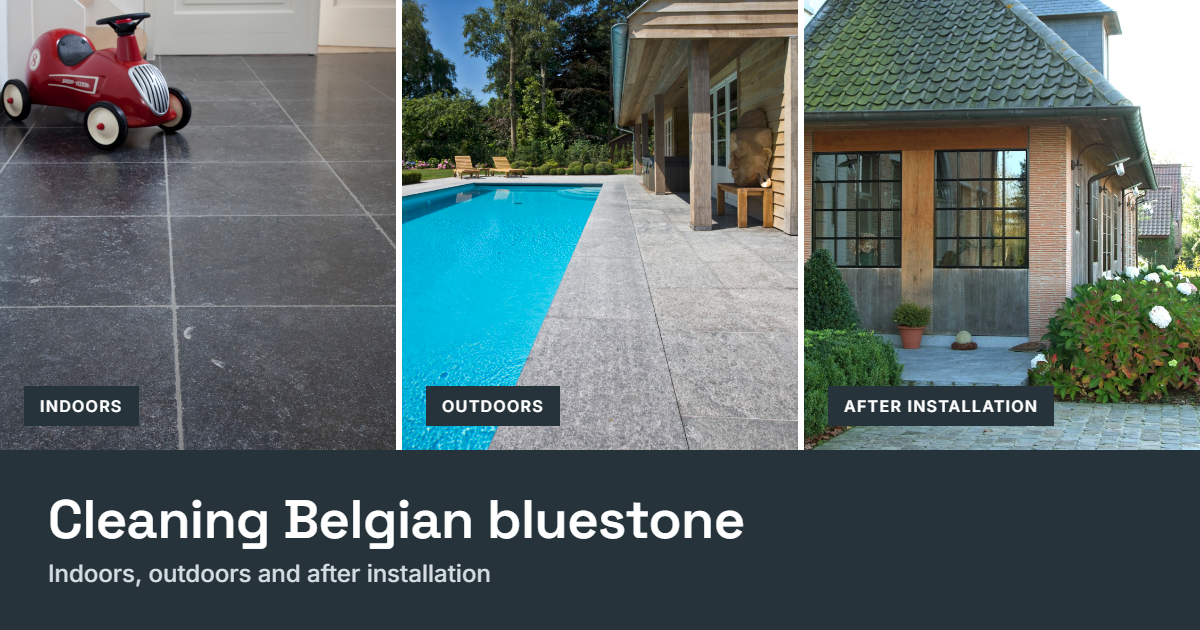
Cleaning bluestone seems simple, but the wrong product can cause permanent damage. Belgian bluestone, also known as petit granit or pierre bleue, is a limestone and therefore reacts differently from granite or ceramics. In this guide you'll learn how to clean bluestone indoors and outdoors, how to remove algae, efflorescence and cement haze, and what you should never do. Practical advice from STONE NV, for owners across Europe, the United States and the Middle East.
Why bluestone reacts differently
Bluestone is hard and frost-resistant, but chemically it is a limestone: it consists of calcium carbonate and is therefore sensitive to acids. Acidic products such as vinegar, lemon, limescale removers and many standard stone cleaners attack the surface and leave light, dull marks. Bluestone also changes naturally outdoors: under the influence of sun and rain, it gradually turns a lighter grey. That isn't dirt, but a natural patina. Read more about the stone itself on our Belgian bluestone page.
Cleaning bluestone indoors
Indoors, lukewarm water with a mild, pH-neutral natural stone soap is all you need. Mop with a well-wrung mop and wipe up spills straight away, especially in the kitchen. Never use vinegar, lemon or limescale removers, not even in the bathroom: dry wet areas instead to prevent limescale marks. An impregnated floor is better protected against oil, wine and coffee stains.
Cleaning bluestone outdoors: terrace, thresholds and facade
Outdoors, regular sweeping is the best maintenance. Otherwise, leaves, soil and flowerpots leave stains. For a thorough clean of a terrace:
- Sweep the terrace thoroughly and remove loose dirt from the joints.
- Wet the stone with water.
- Clean with a product that is explicitly suitable for bluestone, and a stiff brush or scrubbing machine.
- Rinse thoroughly with water and let it dry completely.
- Re-impregnate if needed once the stone is completely dry.
The same approach applies to thresholds, window sills, stairs and facades, with a softer brush on honed surfaces.
Removing algae and moss
Green deposits form in damp, shady spots because of algae and moss. Remove them with an algae and moss cleaner suitable for natural stone, leave it to work as instructed and then brush it off. Don't use bleach: it can discolour the stone. Impregnation and regular sweeping limit new growth.
Efflorescence and cement haze
- Efflorescence (white deposits) appears when moisture brings lime or salts up from the mortar or the subfloor. On a new terrace it usually disappears by itself. Brush it off dry and don't use acid. If it keeps coming back, ask for advice: the cause often lies in the subfloor.
- Cement haze is the grey film left behind after grouting. Wait until the joints have fully cured and use only an acid-free cement haze remover for limestone. A standard acidic cement haze remover damages bluestone.
What not to do
- A pressure washer used too close: it opens up the surface, makes the stone more porous and quicker to get dirty, and damages the joints. Use it only from a distance and at low pressure.
- Acids and limescale removers: vinegar, lemon, hydrochloric acid and acidic stone cleaners attack bluestone directly.
- Bleach and harsh home remedies: they can discolour the stone and damage the impregnation.
- Linseed oil: it darkens the stone unevenly, yellows and attracts dirt.
- De-icing salt: it can damage bluestone; use it as sparingly as possible.
Protecting bluestone
A natural stone impregnator slows down the absorption of water, dirt and stains, and limits algae growth. Impregnate after installation and after a thorough clean, always on completely dry stone. To keep or bring back the typical dark colour, colour-enhancing products are also available. Do the drop test to know when to re-impregnate: if water no longer beads, it's time.
Is your bluestone dull, discoloured or damaged? A professional can sand and refinish it properly. Discover our natural stone renovation. General tips for all stone types can be found in our article on cleaning and caring for natural stone.
Frequently asked questions about cleaning bluestone
How do you clean bluestone outdoors?
Sweep thoroughly, wet the stone, clean with a product suitable for bluestone and a stiff brush, and rinse thoroughly. Don't use acids or a pressure washer up close.
Can you use vinegar on bluestone?
No. Bluestone is a limestone and vinegar is an acid: it leaves light, dull marks that can't be polished away.
Which product should you use on bluestone?
A mild, pH-neutral soap for everyday cleaning, and for a thorough clean a product that is explicitly suitable for bluestone or limestone. Always check the label and test first on an inconspicuous spot.
Can you use a pressure washer on bluestone?
Preferably not up close. A pressure washer opens up the surface, makes the stone more porous and damages the joints. Use it at most from a distance and at low pressure, and re-impregnate afterwards.
How do you remove efflorescence from bluestone?
On a new terrace, efflorescence usually disappears by itself. Brush it off dry and don't use acid. If it keeps coming back, the cause often lies in the subfloor: ask for advice.
Why does bluestone turn grey outdoors?
Outdoors, under the influence of sun and rain, bluestone gradually turns a lighter grey. This is natural weathering, not dirt. A colour enhancer or a professional restoration can partly bring back the dark colour.
How do you remove rust stains from bluestone?
Rust stains come from metal objects or from iron-bearing minerals naturally present in the stone. Most rust removers are acidic and damage bluestone: use only a product explicitly suitable for limestone, or ask for advice.